
mercoledì 31 ottobre 2012


martedì 30 ottobre 2012
Halloween Pumpkin Cake
Torta di Halloween a forma di zucca

Si avvicina la tanto attesa festa di Halloween, ed abbiamo deciso di preparare per voi delle simpatiche e buonissime torte a forma di zucca che potrete fare per la festa dei vostri bambini. Con un po’ di buona volontà e l’immancabile fantasia realizzerete dei dolci davvero speciali e buonissimi. Seguendo le nostre semplici istruzioni riuscirete a fare una torta originale che di certo non potrete trovare in nessuna pasticceria!
Ingredienti
Per la torta:- cioccolato fondente: 300 gr
- burro: 80 gr
- uova: 6
- zucchero: 160 gr
- farina: 100 gr
- lievito in polvere: 2 cucchiaini
- cacao: 4 cucchiai
- zucchero a velo: qb
- sale: 1 pizzico
- zucchero: 320 gr
- burro: 320
- albumi: 4
- coloranti alimentari: qb
Ricetta e preparazione
Seguite le istruzioni.
- La prima cosa da fare è preparare due torte al cioccolato,potete farle contemporaneamente in due ciotole diverse, oppure una volta, dipende anche dalle teglie. Prendete una planetaria e mettete dentro le uova e lo zucchero, poi aggiungete un pizzico di sale e il burro e il cioccolato fusi insieme a bagnomaria o al microonde. Unite cacao, lievito e farina setacciati insieme e mescolate bene. Imburrate e infarinate uno stampo grande, di quelli che servono per fare le corone di riso o le gelatine, anche certi budini o ciambelle. Cuocete la torta in forno caldo a 180°C per 35 – 40 minuti. Preparate la seconda torta in uno stampo identico. Sfornate le torte e fatele raffreddare su una gratella.
- Preparate la glassa colorata mescolando la glassa bianca semplice con i coloranti alimentari, oppure facendola in casa direttamente con albumi, zucchero a velo e coloranti. Scegliete i colori che volete ma che siano sempre autunnali e che richiamino Halloween tipo arancione, verde e viola. A questo punto preparate la crema al burro. Mettete 120 gr di zucchero e due cucchiaio di acqua in un pentolino, portate a ebollizione e cuocete per altri 3 minuti. Montate gli albumi a neve ben ferma e incorporate lo zucchero gradualmente sbattendo con le fruste elettriche. A questo punto versate la meringa a filo nello sciroppo bollente e mescolate con le fruste fino a quando la crema si sarà raffreddata. Aggiungete il burro morbido, poco per volta, sempre sbattendo con le fruste elettriche. Fate raffreddare e poi aggiungete il colorante arancione, poco per volta, fino ad avere la tonalità desiderata.
- Prendete una torta e mettetela su una teglia con la parte più piccola verso sotto, poi spalmate la parte superiore con la glassa e adagiate sopra l’altra torta in modo da far coincidere i bordi. A questo punto spalmate tutto il dolce con la crema al burro arancione. In alternativa potete usare anche solo la glassa arancione.Fate il picciolo con il marzapane colorato con il colorante verde oppure con la pasta di zucchero.

Consigli
Decorate la vostra zucca con caramelle arancioni tritate.Tortini a forma di zucca


lunedì 29 ottobre 2012


domenica 28 ottobre 2012


Halloween
Halloween (or Hallowe'en) is an annual holiday observed on October 31, which commonly includes activities such as trick-or-treating, attending costume parties, carving jack-o'-lanterns, bonfires, apple bobbing, visiting haunted attractions, playing pranks telling scary stories, and watching horror films.
History
Historian Nicholas Rogers, exploring the origins of Halloween, notes that while "some folklorists have detected its origins in the Roman feast of Pomona, the goddess of fruits and seeds, or in the festival of the dead called Parentalia, it is more typically linked to the Celtic festival of Samhain, whose original spelling was Samuin (pronounced sow-an or sow-in)".
The name of the festival historically kept by the Gaels and Celts in the British Isles is derived from Old Irish and means roughly "summer's end".
According to the Oxford Dictionary of English folk lore: "Certainly Samhain was a time for festive gatherings, and medieval Irish texts and later Irish, Welsh, and Scottish folklore use it as a setting for supernatural encounters, but there is no evidence that it was connected with the dead in pre-Christian times, or that pagan religious ceremonies were held."
The Irish myths which mention Samhain were written in the 10th and 11th centuries by Christian monks. This is around 200 years after the Catholic church inaugurated All Saints Day and at least 400 years after Ireland became Christian.
Origin of name
The word Halloween is first attested in the 16th century and represents a Scottish variant of the fuller All-Hallows-Even ("evening"), that is, the night before All Hallows Day. Although the phrase All Hallows is found in Old English (ealra hālgena mæssedæg, mass-day of all saints), All-Hallows-Even is itself not attested until 1556.
Symbols
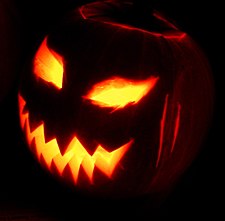
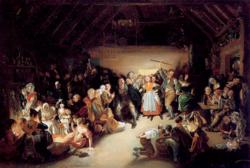
Development of artifacts and symbols associated with Halloween formed over time. For instance, the carving of jack-o'-lanterns springs from the souling custom of carving turnips into lanterns as a way of remembering the souls held in purgatory. The turnip has traditionally been used in Ireland and Scotland at Halloween, but immigrants to North America used the native pumpkin, which are both readily available and much larger – making them easier to carve than turnips. The American tradition of carving pumpkins is recorded in 1837 and was originally associated with harvest time in general, not becoming specifically associated with Halloween until the mid-to-late 19th century.
The imagery of Halloween is derived from many sources, including national customs, works of Gothic and horror literature (such as the novels Frankenstein and Dracula), and classic horror films (such as Frankenstein and The Mummy). Among the earliest works on the subject of Halloween is from Scottish poet John Mayne in 1780, who made note of pranks at Halloween; "What fearfu' pranks ensue!", as well as the supernatural associated with the night, "Bogies" (ghosts), influencing Robert Burns' Halloween 1785. Elements of the autumn season, such as pumpkins, corn husks, and scarecrows, are also prevalent. Homes are often decorated with these types of symbols around Halloween.
Halloween imagery includes themes of death, evil, the occult, or mythical monsters. Black and orange are the holiday's traditional colors.
Trick-or-treating and guising
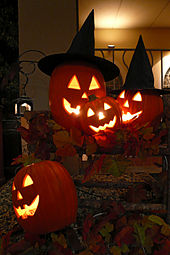
Trick-or-treating is a customary celebration for children on Halloween. Children go in costume from house to house, asking for treats such as candy or sometimes money, with the question, "Trick or treat?" The word "trick" refers to a (mostly idle) "threat" to perform mischief on the homeowners or their property if no treat is given. In some parts of Scotland children still go guising. In this custom the child performs some sort of trick, i.e. sings a song or tells a ghost story, to earn their treats.
The practice of dressing up in costumes and begging door to door for treats on holidays dates back to the Middle Ages and includes Christmas wassailing. Trick-or-treating resembles the late medieval practice of souling, when poor folk would go door to door on Hallowmas (November 1), receiving food in return for prayers for the dead on All Souls' Day (November 2). It originated in Ireland and Britain, although similar practices for the souls of the dead were found as far south as Italy. Shakespeare mentions the practice in his comedy The Two Gentlemen of Verona (1593), when Speed accuses his master of "puling [whimpering or whining] like a beggar at Hallowmas."In Scotland and Ireland, Guising — children disguised in costume going from door to door for food or coins — is a traditional Halloween custom, and is recorded in Scotland at Halloween in 1895 where masqueraders in disguise carrying lanterns made out of scooped out turnips, visit homes to be rewarded with cakes, fruit and money. The practise of Guising at Halloween in North America is first recorded in 1911, where a newspaper in Kingston, Ontario reported children going "guising" around the neighborhood.
American historian and author Ruth Edna Kelley of Massachusetts wrote the first book length history of the holiday in the U.S; The Book of Hallowe'en (1919), and references souling in the chapter "Hallowe'en in America";The taste in Hallowe'en festivities now is to study old traditions, and hold a Scotch party, using Burn's poem Hallowe'en as a guide; or to go a-souling as the English used. In short, no custom that was once honored at Hallowe'en is out of fashion now.
In her book, Kelley touches on customs that arrived from across the Atlantic; "Americans have fostered them, and are making this an occasion something like what it must have been in its best days overseas. All Hallowe'en customs in the United States are borrowed directly or adapted from those of other countries".
While the first reference to "guising" in North America occurs in 1911, another reference to ritual begging on Halloween appears, place unknown, in 1915, with a third reference in Chicago in 1920.
The earliest known use in print of the term "trick or treat" appears in 1927, from Blackie, Alberta, Canada:Hallowe’en provided an opportunity for real strenuous fun. No real damage was done except to the temper of some who had to hunt for wagon wheels, gates, wagons, barrels, etc., much of which decorated the front street. The youthful tormentors were at back door and front demanding edible plunder by the word “trick or treat” to which the inmates gladly responded and sent the robbers away rejoicing.
The thousands of Halloween postcards produced between the turn of the 20th century and the 1920s commonly show children but do not depict trick-or-treating. The editor of a collection of over 3,000 vintage Halloween postcards writes, "There are cards which mention the custom [of trick-or-treating] or show children in costumes at the doors, but as far as we can tell they were printed later than the 1920s and more than likely even the 1930s. Tricksters of various sorts are shown on the early postcards, but not the means of appeasing them". Trick-or-treating does not seem to have become a widespread practice until the 1930s, with the first U.S. appearances of the term in 1934, and the first use in a national publication occurring in 1939.
Costumes
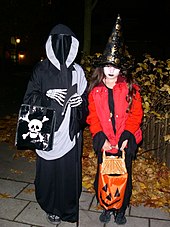
Halloween costumes are traditionally modeled after supernatural figures such as monsters, ghosts, skeletons, witches, and devils. Over time, the costume selection extended to include popular characters from fiction, celebrities, and generic archetypes such as ninjas and princesses.
Dressing up in costumes and going "guising" was prevalent in Scotland at Halloween by the late 19th century. Costuming became popular for Halloween parties in the US in the early 20th century, as often for adults as for children. The first mass-produced Halloween costumes appeared in stores in the 1930s when trick-or-treating was becoming popular in the United States.
Halloween costume parties generally fall on, or around, 31 October, often falling on the Friday or Saturday prior to Halloween.
UNICEF
"Trick-or-Treat for UNICEF" has become a common sight during Halloween in North America. Started as a local event in a Northeast Philadelphia neighborhood in 1950 and expanded nationally in 1952, the program involves the distribution of small boxes by schools (or in modern times, corporate sponsors like Hallmark, at their licensed stores) to trick-or-treaters, in which they can solicit small-change donations from the houses they visit. It is estimated that children have collected more than $118 million for UNICEF since its inception. In Canada, in 2006, UNICEF decided to discontinue their Halloween collection boxes, citing safety and administrative concerns; after consultation with schools, they instead redesigned the program.

Games and other activities
There are several games traditionally associated with Halloween parties. One common game is dunking or apple bobbing, in which apples float in a tub or a large basin of water and the participants must use their teeth to remove an apple from the basin. A variant of dunking involves kneeling on a chair, holding a fork between the teeth and trying to drop the fork into an apple. Another common game involves hanging up treacle or syrup-coated scones by strings; these must be eaten without using hands while they remain attached to the string, an activity that inevitably leads to a very sticky face.
Some games traditionally played at Halloween are forms of divination. A traditional Scottish form of divining one's future spouse is to carve an apple in one long strip, then toss the peel over one's shoulder. The peel is believed to land in the shape of the first letter of the future spouse's name. Unmarried women were told that if they sat in a darkened room and gazed into a mirror on Halloween night, the face of their future husband would appear in the mirror. However, if they were destined to die before marriage, a skull would appear. The custom was widespread enough to be commemorated on greeting cards from the late 19th century and early 20th century.
Another game/superstition that was enjoyed in the early 1900s involved walnut shells. People would write fortunes in milk on white paper. After drying, the paper was folded and placed in walnut shells. When the shell was warmed, milk would turn brown therefore the writing would appear on what looked like blank paper. Folks would also play fortune teller. In order to play this game, symbols were cut out of paper and placed on a platter. Someone would enter a dark room and was ordered to put her hand on a piece of ice then lay it on a platter. Her "fortune" would stick to the hand. Paper symbols included: dollar sign-wealth, button-bachelorhood, thimble-spinsterhood, clothespin- poverty, rice-wedding, umbrella- journey, caldron-trouble, 4-leaf clover- good luck, penny-fortune, ring-early marriage, and key-fame.
The telling of ghost stories and viewing of horror films are common fixtures of Halloween parties. Episodes of television series and Halloween-themed specials (with the specials usually aimed at children) are commonly aired on or before the holiday, while new horror films are often released theatrically before the holiday to take advantage of the atmosphere.

Haunted attractions
Haunted attractions are entertainment venues designed to thrill and scare patrons. Most attractions are seasonal Halloween businesses. Origins of these paid scare venues are difficult to pinpoint, but it is generally accepted that they were first commonly used by the Junior Chamber International (Jaycees) for fundraising. They include haunted houses, corn mazes, and hayrides, and the level of sophistication of the effects has risen as the industry has grown. Haunted attractions in the United States bring in an estimate $300–500 million each year, and draw some 400,000 customers, although press sources writing in 2005 speculated that the industry had reached its peak at that time. This maturing and growth within the industry has led to more technically-advanced special effects and costuming, comparable with that of Hollywood films.

Foods
Because the holiday comes in the wake of the annual apple harvest, candy apples (known as toffee apples outside North America), caramel or taffy apples are common Halloween treats made by rolling whole apples in a sticky sugar syrup, sometimes followed by rolling them in nuts.
At one time, candy apples were commonly given to children, but the practice rapidly waned in the wake of widespread rumors that some individuals were embedding items like pins and razor blades in the apples. While there is evidence of such incidents, they are quite rare and have never resulted in serious injury. Nonetheless, many parents assumed that such heinous practices were rampant because of the mass media. At the peak of the hysteria, some hospitals offered free X-rays of children's Halloween hauls in order to find evidence of tampering. Virtually all of the few known candy poisoning incidents involved parents who poisoned their own children's candy.
One custom that persists in modern-day Ireland is the baking (or more often nowadays, the purchase) of a barmbrack (Irish: báirín breac), which is a light fruitcake, into which a plain ring, a coin and other charms are placed before baking. It is said that those who get a ring will find their true love in the ensuing year. This is similar to the tradition of king cake at the festival of Epiphany.

List of foods associated with the holiday:
- Barmbrack (Ireland)
- Bonfire toffee (Great Britain)
- Candy apples/toffee apples (Scotland & Ireland)
- Candy corn, candy pumpkins (North America)
- Caramel apples
- Caramel corn
- Colcannon (Ireland)
- Novelty candy shaped like skulls, pumpkins, bats, worms, etc.
- Pumpkin, pumpkin pie, pumpkin bread
- Roasted pumpkin seeds
- Roasted sweet corn
- Soul cakes
Around the world
Halloween is not celebrated in all countries and regions of the world, and among those that do the traditions and importance of the celebration vary significantly. In Scotland and Ireland, traditional Halloween customs include children dressing up in costume going "guising", holding parties, while other practices in Ireland include lighting bonfires, and having firework displays. Mass transatlantic immigration in the 19th century popularized Halloween in North America, and celebration in the United States and Canada has had a significant impact on how the event is observed in other nations. This larger North American influence, particularly in iconic and commercial elements, has extended to places such as South America, Australia, New Zealand, continental Europe, Japan, and other parts of East Asia.
Religious perspectives
Christianity
Christian attitudes towards Halloween are diverse. In the Anglican Church, some dioceses have chosen to emphasize the Christian traditions of All Saints’ Day, while some other Protestants celebrate the holiday as Reformation Day, a day to remember the Protestant Reformation. Father Gabriele Amorth, a Vatican-appointed exorcist in Rome, has said, "if English and American children like to dress up as witches and devils on one night of the year that is not a problem. If it is just a game, there is no harm in that." In more recent years, the Roman Catholic Archdiocese of Boston has organized a "Saint Fest" on the holiday. Similarly, many contemporary Protestant churches view Halloween as a fun event for children, holding events in their churches where children and their parents can dress up, play games, and get candy for free.
Many Christians ascribe no negative significance to Halloween, treating it as a purely secular holiday devoted to celebrating "imaginary spooks" and handing out candy. To these Christians, Halloween holds no threat to the spiritual lives of children: being taught about death and mortality, and the ways of the Celtic ancestors actually being a valuable life lesson and a part of many of their parishioners' heritage. In the Roman Catholic Church, Halloween is viewed as having a Christian connection, and Halloween celebrations are common in Catholic parochial schools throughout North America and in Ireland.
Some Christians feel concerned about Halloween, and reject the holiday because they feel it trivializes – or celebrates – paganism, the occult, or other practices and cultural phenomena deemed incompatible with their beliefs. A response among some fundamentalist and conservative evangelical churches in recent years has been the use of "Hell houses", themed pamphlets, or comic-style tracts such as those created by Jack T. Chick in order to make use of Halloween's popularity as an opportunity for evangelism. Some consider Halloween to be completely incompatible with the Christian faith believing it to have originated as a pagan "Festival of the Dead".
Paganism
Celtic NeoPagans consider the season a holy time of year. Celtic Reconstructionists, and others who maintain ancestral customs, make offerings to the gods and the ancestors.
.jpg)
Cucina con Ale 4 - Tutte le Ricette della Quarta Stagione
Episodio 40
Lasagna light

Ingredienti (per 4 persone)
12 albumi
250 gr di mozzarella light
400 gr di salsa di pomodoro già fatta
Un mazzetto di timo
25 gr di burro (per la lasagna e per imburrare la teglia)
30 gr di parmigiano grattugiato
Zafferano in polvere
Sale
Pepe
Olio
Sbatto gli albumi con sale, pepe e zafferano e li verso poco alla volta in una padella ampia e unta con l’olio per formare sottili frittate. Appena pronte le taglio a quadrati di circa 6 cm di lato.
Poi imburro una pirofila e la rivesto con strati di quadrati di frittata di albumi alternati alla salsa di pomodoro, alle fettine di mozzarella e al parmigiano. Termino con uno strato di parmigiano e con fiocchi di burro. Passo in forno la lasagna per 15 minuti a 180°, poi la sforno e la decoro con foglie di timo.
Spring roll di anatra

Ingredienti (per 4 persone)
600 g di petto d’anatra
1 rotolo di pasta fillo
1 arancia
100 g di burro
Burro fuso qb
Cannella in polvere
Chiodi di garofano
Noce moscata
Sale
1/2 bicchiere di brodo di carne
1 bicchiere di Vino bianco
Radicchio trevigiano
Aceto balsamico
Pepe
Taglio il petto d’anatra a pezzi piccoli e faccio rosolare in padella con il burro, sfumo con il vino bianco e poi lascio cuocere aggiungendo il sale, il pepe, i chiodi di garofano, un pizzico di cannella, un pizzico di noce moscata, la scorza di arancia grattugiata, il succo dell’arancia spremuto e il brodo.
Nel frattempo ritaglio la pasta fillo, spennello col burro fuso la superficie, posiziono qualche pezzetto di anatra su ogni quadrato e li richiudo a pacchetto. Spennello con il burro fuso e cuocio in forno a 180° per 5 minuti o per il tempo sufficiente a renderli croccanti. Nel frattempo lucido in padella il radicchio tagliato finemente.
Sforno i fagottini di anatra e li impiatto con il radicchio trevigiano ripassato in padella e guarnisco con la riduzione di aceto balsamico.
Happy hour

Ingredienti (per 2 persone)
4 gamberi rossi già puliti lasciando la testa e coda
50 g di anacardi tostati e salati
1 bicchiere di aperitivo alcolico
Erba cipollina
Sale
Olio evo
Pepe
Trito gli anacardi con il batticarne fino a polverizzarli. Metto l’aperitivo alcolico a ridursi in padella con sale e pepe finché non risulti di consistenza sciropposa, quindi lo lascio raffreddare.
Impano i gamberi con il trito di anacardi e li metto a rosolare in padella per pochi secondi con olio, sale e pepe.
Una volta rosolati, impiatto con la riduzione di aperitivo e aggiungo un ciuffo di erba cipollina.
.jpg)

Cucina con Ale 4 - Tutte le Ricette della Quarta Stagione
Episodio 39
Calzoncelli di baccalà

Ingredienti (per 4 persone)
400 g di pasta per pizza già lievitata
350 g di baccalà
350 g di patate sbollentate
150 g di pomodori Piccadilly
1 cipolla
Prezzemolo
Peperoncino fresco
Olio evo
Sale
In una padella con abbondante olio metto a soffriggere un battuto di cipolla, prezzemolo, peperoncino. Aggiungo il sale e i pomodori, dopo aver tagliato grossolanamente il baccalà e le patate unisco tutto al soffritto, lascio insaporire.
Tiro la pasta per pizza in sfoglia e ne ricavo tre dischi, riempio con il condimento e richiudo a calzone.
Friggo i calzoncelli, scolo l’olio in eccesso e servo.
Sformato di pollo e champignons

Ingredienti (per 4 persone)
3 uova
150 g di petto di pollo
25 g di parmigiano reggiano grattugiato
Prezzemolo
1 spicchio d'aglio
Olio evo
Sale
Farina qb
Burro qb
Taglio il pollo a listarelle e lo metto a rosolare in padella con un filo d’olio. Aggiungo l’aglio schiacciato, il sale, il prezzemolo e i funghi tagliati a fettine.
Monto le uova con il parmigiano. Aggiungo poi, il pollo sminuzzato rosolato con i funghi. Imburro e infarino gli stampini, li riempio di impasto e cuocio per circa 20 minuti a 180° circa.
A cottura ultimata, impiatto gli sformatini, li taglio a fettine e alterno a fettine di sformato fettine di funghi e ciuffi di prezzemolo.
Tarare di fragole e cioccolato con tartufi di banana

Ingredienti (per 4 persone)
10 fragole
80 g di cioccolato fondente al 55%
1/3 di baccello di vaniglia
Zucchero a velo
8 foglie di menta
2 banane
50 g di cacao amaro
Acqua qb
Taglio le fragole a dadi che passo nella polvere di cacao ricoprendole perfettamente, aggiungo foglioline di menta.
Taglio la banana a rondelle e la mescolo con lo zucchero a velo e i semi del baccello di vaniglia e un filo d’acqua. Preparo la tartare aiutandomi con un ring, dispongo sul fondo le banane alla vaniglia, poi le fragole al cacao e menta, copro con fettine di fragole fresche e guarnisco con una fogliolina di menta e scaglie di cioccolato.
giovedì 25 ottobre 2012


.jpg)
Cucina con Ale 4 - Tutte le Ricette della Quarta Stagione
Episodio 38
Cestini di spaghetti con caponatina leggera

Ingredienti (per 4 persone)
200 g di spaghetti già cotti al dente
2 carote
6 asparagi
1/2 melanzana
1 pomodoro a grappolo
1 cipolla bianca
1 spicchio d’aglio
1 cucchiaio di pinoli
1 cucchiaio di uvetta reidratata
1 cucchiaino di capperi dissalati
1 cucchiaio di olive nere denocciolate
Olio evo
Olio per friggere
Basilico
Brodo vegetale qb
Sale
Aceto balsamico
Trito la cipolla e la faccio imbiondire in padella con dell’olio, i pomodori tagliati a cubetti, aggiungo la melanzana tagliata a cubetti piccoli ed uno spicchio d’aglio schiacciato, poi gli asparagi tagliati a rondelle e le carote tagliate a dadini, sfumo con un po’ di brodo e lascio cuocere. Aggiungo i pinoli, l’uvetta, i capperi e le olive. Sfumo con un po’ d’aceto balsamico.
Metto una porzione nel doppio colino per cestini e la immergo in abbondante olio per friggere per 2 o 3 minuti, finché gli spaghetti non risulteranno ben dorati. Scolo il cestino e lascio freddare. ripeto lo stesso procedimento utilizzando tutti gli spaghetti.
Impiatto i cestini riempiti con la caponatina e decoro con basilico fresco e olio evo.
Insalata di fichi e lonza

Ingredienti (per 4 persone)
8 fichi freschi buccia nera
100 gr di lonza
100 gr di insalata Lollo rossa
100 gr di radicchio rosso
8 foglie di basilico
4 fette di pane casareccio
2 cucchiaino di miele
2 cucchiaio di olio extra vergine
2 cucchiaino di senape di Digione
2 cucchiaino di aceto
Sale
Taglio a dadini il pane e lo tosto in padella, quindi lo verso in una ciotola con i fichi freschi tagliati a metà e le insalate. In una padella faccio diventare croccante la lonza tagliata a listarelle e la unisco agli altri ingredienti nella ciotola. Servo l’insalata e la condisco con l’emulsione fatta miscelando olio, senape, aceto, sale e miele. Guarnisco con foglie di basilico.
Biscotti al cocco

Ingredienti (per 4 persone)
250 g farina di cocco
100 g farina di riso
250 g di zucchero
50 g di burro fuso
3 uova
Foglioline di menta
Per la salsa di frutta
15 albicocche secche
15 castagne lesse
1 piccola mela rossa
Burro qb
1/2 Vin santo
In una terrina mescolo lo zucchero, le uova, il burro fuso e le due farine e amalgamo bene il tutto. Dall’impasto ricavo tante palline e le adagio su una teglia foderata di carta da forno e le metto a cuocere in forno a 180°per 20 minuti o fino a quando saranno dorati e croccanti. Nel frattempo, taglio la mela in spicchi e la rosolo nel burro, quindi aggiungo le albicocche a filetti, le castagne sbriciolate e il 1\2 bicchiere di Vin santo. Lascio rapprendere e frullo il tutto fino ad ottenere una purea di frutta. Servo i biscotti sulla purea di frutta e guarnisco con foglioline di menta.
mercoledì 24 ottobre 2012


Cucina con Ale 4 -Tutte le Ricette della Quarta Stagione
Episodio 37
Insalata insolita

Ingredienti (per 2 persone)
1 avocado
100 g di fagiolini sbianchiti
2 pomodori camone
1 costa di sedano
1 limone
3 peperoni rossi e gialli
1 cipollina fresca
1 cucchiaio di capperi sotto sale dissalati
2 cucchiai di olive taggiasche
Basilico
Aglio
Olio extra
Sale
Pepe
Aceto balsamico
Taglio il sedano a pezzettini, il pomodoro a listarelle elimando la polpa. Sbuccio l’avocado e ne estraggo la polpa con uno scavino. Affetto il cipollotto finemente e taglio il peperone a dadini.
Metto il tutto in una ciotola, aggiungendo i fagiolini, i capperi, le olive, qualche pezzettino d’aglio ed il basilico, condisco con il sale, l’olio, del pepe, un filo d’aceto e zest di limone.
Trucchi in cucina

Ingredienti (per 4 persone)
Rimedio 1
Insalata mista verde
Olio
Aceto
Sale
Mollica di pane
Rimedio 2
Maionese impazzita in contenitore con becco
Uovo
Rimedio 3
Budino
Rimedio 1
Se nel condire l’insalata si è versato troppo aceto, per rimediare basta inserire due pezzi di mollica di pane e girare bene l’insalata. La mollica assorbirà buona parte dell’aceto in eccedenza, e andrà ovviamente eliminata.
Rimedio 2
Per recuperare la maionese impazzita, si riparte dal tuorlo fresco e si monta con la maionese impazzita. Il trucco sta nell’utilizzare la forte concentrazione di lecitina che è nel tuorlo, che piano piano “aggancerà “ il grasso.
Rimedio 3
Quando un budino non vuole proprio staccarsi dalle pareti dello stampo, un phon può esserci d’aiuto: bisognerà capovolgere il budino nel suo contenitore su di un piatto e scaldare il fondo con il phon per alcuni secondi.
Garganelli alla gallinella di mare

Ingredienti (per 4 persone)
320 g di garganelli
300 g di filetto di gallinella di mare
500 g di bieta
1 scalogno
1 spicchio d’aglio
Prezzemolo
Peperoncino secco
Olio extra
1 cucchiaio di concentrato di pomodoro
Sale
Metto a cuocere i garganelli in acqua bollente salata. Nel frattempo rosolo in padella lo scalogno tritato con olio, aglio.
Taglio il filetto di gallinella di mare a bocconcini che rosolo in padella con l’olio, aggiungo un cucchiaio di concentrato di pomodoro, un cucchiaio di acqua della pasta, le erbette, e il sale.
Scolo i garganelli e li manteco in padella con il condimento e un pezzetto di peperoncino.
Taglio la bieta finemente e la lucido in una padella con un filo d’olio. A piacere si può aggiungere del prezzemolo tritato.
martedì 23 ottobre 2012


Cucina con Ale 4 - Tutte le Ricette della Quarta Stagione
Episodio 36
Astice alla catalana

Ingredienti (per 4 persone)
2 astici da 600 gr ciascuna già bolliti
300 g di pomodori Piccadilly
2 cipolle rosse di Tropea
1 costa di sedano
1 cucchiaio di aceto di vino rosso
Olio evo
Sale
Pepe
Basilico
Prendo la polpa di astice e la taglio a pezzetti. In un biberon preparo un’emulsione con l'olio, l’aceto, il sale e il pepe.
Taglio finemente le cipolle e il sedano, taglio i pomodori e li metto insieme in una ciotola con il basilico. Condisco poi l'aragosta con la cipolla, il sedano, i pomodori, il basilico e l'emulsione.
Impiatto con un filo d’olio a crudo e foglie di basilico.
Le insolite polpette

Ingredienti (per 4 persone)
250 g di manzo tritato
250 g di vitello tritato
50 g di mortadella a fettine sottili
1 porro
1 uovo
Pangrattato qb
Pepe
Sale
Olio
1 cucchiaio di capperi sott’aceto
Gambi di prezzemolo
1 cucchiaio di olio di oliva
Mescolo le carni alla mortadella tagliata a pezzetti, all’uovo, al sale e al pepe, formo delle polpettine e le passo nel pan grattato. Le metto a cuocere in una padella con un filo d’olio e, in un’altra faccio rosolare con dell’olio il porro tagliato a fettine.
Nel frattempo, frullo i capperi con i gambi di prezzemolo e un cucchiaio di olio.
Mescolo i due composti e impiatto le polpette su un letto di porri rosolati, e ricopro con la salsa ai capperi.
Tarte tatin di pere

Ingredienti (per 4 persone)
300 g di pasta sfoglia
2 pere
80 g di margarina
3 cucchiai di zucchero di canna
25 ml di liquore di pera
200 ml di panna vegetale montata
2 cucchiai di zucchero a velo
Semi di cardamomo
Faccio rosolare le pere tagliate a fettine con la buccia in una padella con la margarina. Aggiungo lo zucchero di canna per farle caramellare e sfumo con un cucchiaio di liquore di pera.
Riempio degli stampini con le pere e poi li ricopro con la pasta sfoglia precedentemente stesa. Inforno a 200° per un quarto d’ora circa.
Sformo le tarte tatin e le impiatto con la panna vegetale aromatizzata con dei semi di cardamomo e aggiungo una spolverata di zucchero a velo.

